

Desa Oculus, Bali: Inside the Design Hotel Built Around Mount Batur
A Hotel Built Around a Volcano on the Kedisan Ridge
Most Bali boutique hotels are decorated. Desa Oculus is built. There is a difference, and on the Kedisan ridge above Lake Batur, that difference is the entire point.
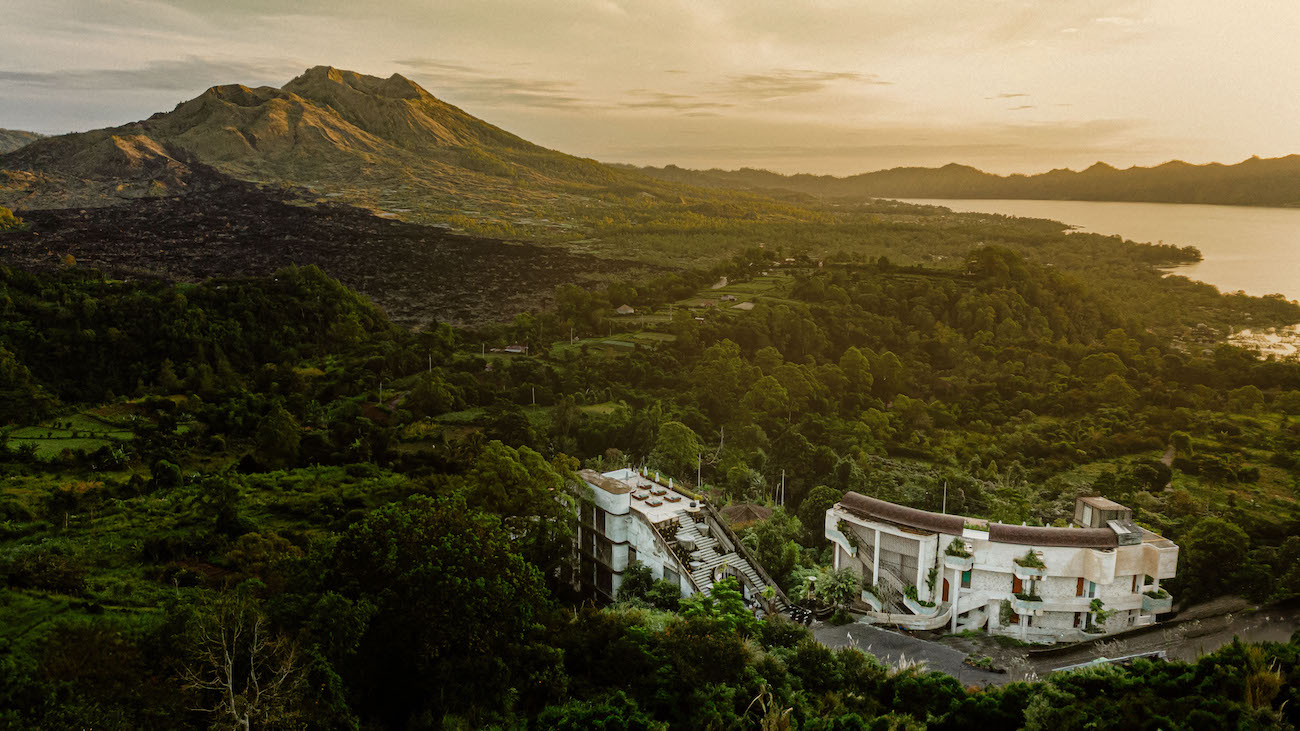
Opened in 2022, the property is the work of Manguning Studio, an architectural practice that treats hospitality not as a service category but as a discipline. Their brief for Oculus was severe: take Kintamani’s volcanic topography and translate it into a building whose structure climbs the mountain it watches. Two terraced buildings are dug into the ridge, and a vertical programme is stacked like the ascent itself — suites at the base, lobby above, the restaurant above that, and at the peak an open-air events platform called Ruang Langit. Every level is oriented strictly north. Every level is a curated frame.
And the frame is for Mount Batur. The building’s name is its design rule.

The Architecture of Attention
A concept this pure could read as architectural posturing. It survives the visit because the thesis is doing real work. You arrive at the lower of the two buildings — defined by a monumental concrete facade staircase that has recently completed construction — and the experience is immediately, and deliberately, vertical. You climb to your suite. You climb to dine. You climb to the rooftop, where the volcano finally opens. The building does not deliver Mount Batur in one shot; it makes you earn it, floor by floor. By the time you reach the top, the metaphor has stopped being a metaphor. You have, in fact, climbed.
This is the part photography cannot communicate. Pictures show the floating breakfast, the suite, the framed view. What they cannot capture is the directional logic — the way every interior space faces the same direction, north, toward Mount Batur, like a building turned in prayer. In Balinese cosmology, the direction toward the sacred mountain — kaja — is the spiritual axis, and Manguning has built that axis into the structure itself. At Desa Oculus you do not choose your view. The architecture has chosen for you, and the choice is the right one.
For design-minded travellers, this is the proposition that separates the property from every other Kintamani retreat: an architectural idea that could not be manufactured anywhere else, executed with the seriousness it deserves.
Getting There: The Journey Into Highland Bali
The drive up is the first act of the stay. Two hours from Ubud, give or take, as scooter traffic gives way to lava fields, steep-cut hillsides and mist drifting across volcanic terrain. By the time you step out of the car, the air has gone thin and crisp in a way Bali otherwise refuses to be. There is a silence here that is not absolute but underwater — the silence you only find at altitude. It is this arrival ritual, as much as the destination, that makes Desa Oculus feel like a genuine escape rather than another stop on the Bali circuit.
When to See Mount Batur: Timing Your Stay
The mountain, it must be said, is not always there. Mount Batur disappears behind cloud for hours, sometimes days; mid-afternoon visibility is unreliable, and full wet-season afternoons can be entirely opaque. The hotel does not pretend otherwise, which is the right call. Visibility becomes a reward for staying long enough to catch the right window — which is why we recommend two nights minimum. Stay one and you may never see what the building is oriented toward.
When the mountain does appear — most reliably at sunrise, and in the hour after rain — the architecture earns itself. The oculus framing is at its most theatrical then, the volcano emerging through the building’s apertures as if released by them. It is the moment the entire project resolves into a single image, and you finally understand why every detail has been turned in this one direction.
Here is the insider’s move, and it is the best decision you can make at this property: skip the dawn hike. The 4am Mount Batur climb, immortalised in every Bali reel, is also where every other tourist is — a headlamp queue before sunrise. Instead, set an alarm for 5:45 and watch the volcano come up through Manguning’s north-facing geometry from your own suite. It is the experience the hotel does not advertise, and arguably the one it was built for.

The Rooms: Atmosphere Over Excess
The suites lean atmosphere over excess — raw stone, dark tones, careful symmetry, light dropped in exactly where the architecture wants it. The bed is good. The bathroom is composed. The unwavering orientation toward Batur lends even a slow morning a sense of occasion.
Where the property still shows its newness: wifi that comes and goes, occasional sound transfer between suites depending on the neighbours, and water pressure that dips at peak shower hours. None of it ruined anything; all of it is the honest price of being there in the building’s first chapter. The cold, meanwhile, is real and worth its own paragraph. At 1,500 metres this is not tropical-cold but genuinely chilly, requiring a proper sweater rather than a linen overshirt — pack layers for evenings, and more for mornings. Even the famous floating breakfast, the composition the property is photographed with, behaves differently in practice than in the picture. It looks like Seminyak in the photograph; at altitude it is brisk, beautiful and best finished before your coffee cools.

Kedisan: The Restaurant Worth the Climb
Kedisan, the restaurant, surprises. Destination hotels at remote elevations usually serve food that is good for the location. This food is good for itself. A slow-cooked beef dish — rich, dark, calibrated to the climate it is eaten in — is the one that lingers. Cocktails are restrained, which at this point in the Bali F&B arc qualifies as a personality trait. The dual-perspective dining arrangement, an intimate room on one side and the pool’s edge on the other, reads on paper like branding language and works in practice as two distinct moods to choose between depending on the weather and the company.
Service follows the same logic: local-warm rather than international-polished. A member of staff, noticing us return from the cold morning air, brought ginger tea without being asked — the sort of gesture that tells you more about how a place runs than any spa menu. Manguning has designed a building that demands a certain kind of attention from its team: slow, observant, in tune with the rhythm of climbing and arriving. The team appear to understand the assignment.
Desa Oculus At A Glance
Setting:
Kedisan Ridge, above Lake Batur in Bali’s highland Kintamani region
Location:
Approximately two hours’ drive from Ubud, at 1,500 metres altitude
Opened:
2022
Hotel Concept:
Architecture built around a volcano — every level oriented strictly north toward Mount Batur, the sacred *kaja* direction in Balinese cosmology
Architect:
Manguning Studio
Accommodation:
Suites across two terraced buildings dug into the ridge, stacked from base to peak
Signature Spaces:
Ruang Langit, the open-air rooftop events platform at the summit of the building’s vertical climb
Dining & Bars:
Kedisan restaurant with dual-perspective dining — an intimate room on one side, pool-edge seating on the other
Unique Experience:
Skipping the 4am dawn hike and watching Mount Batur rise through the building’s north-facing geometry from your own suite at sunrise
Best For:
Couples, design-minded travellers and those seeking quiet, atmospheric luxury beyond the beach
Know Before You Go:
Real cold at 1,500 metres — pack a proper sweater; Mount Batur is most reliably visible at sunrise and the hour after rain; two nights minimum recommended
Website:
desaoculus.com
Editor’s Highlight:
The sunrise moment at Ruang Langit, when the volcano emerges through the building’s apertures as if released by them
Desa Oculus • Kedisan • Kintamani • Bali • Indonesia
Who Desa Oculus Is For — and Who It Isn’t
The crowd skews couples, design-conscious travellers and those travelling with a camera in hand — not families. By four in the afternoon the pool reads social on a clear day and meditative on a misty one, and both versions work. The misty version, for what it is worth, is the one we would choose.
Desa Oculus is priced to compete with international design resorts. What it offers in return is not their polish — it does not quite reach that yet — but the specificity of an architectural idea you cannot manufacture: you pay for the building, the orientation, the climb, and the mountain that is and isn’t there. It is a real proposition or it is not, depending on what you came for.
Equally, it pays to know who it is not for. Anyone who wants Bali to mean beach. Anyone whose definition of luxury is uninterrupted wifi and weather that performs on command. Anyone who measures a hotel by the number of its restaurants. Desa Oculus is moodier and more disciplined than that, and it works precisely because it never pretends otherwise.

The Verdict: Why Desa Oculus Is Worth the Stay
Desa Oculus asks more of its guests than the day trip does, and rewards more in return. On a clear morning at six, standing at Ruang Langit with the volcano rising through the building’s deliberate north-facing geometry, what Manguning has built becomes obvious: an architecture that turns staying into looking, and looking into a kind of attention Bali rarely demands of you. That is the wager. It pays.
For the traveller seeking Bali’s next chapter — beyond the beach clubs, beyond the boho villas — this is one of the island’s most original propositions: a hotel that is less a place to sleep than a machine for watching a mountain wake up.
For more information and bookings visit https://desaoculus.com/
Explore the Full Bali Luxury Travel Guide 2026
From the cliffside resorts of Uluwatu and the creative energy of Canggu to the wellness retreats of Ubud and the beach clubs of Seminyak, Bali remains one of the world’s most compelling luxury destinations.
Discover our complete Bali destination guide featuring the island’s finest hotels, restaurants, beach clubs, wellness escapes and travel experiences:
View the Bali Luxury Travel Guide
Luxury Travel Guide Series • Bali Edition