

Shore Amora, Bali: The Pererenan Design Hotel Organised Around a Living Rice Paddy
One Kilometre From the Crowd, A World Away in Spirit
There comes a point on Bali’s southwest coast where the island’s most famous neighbourhood loosens its grip, and for many seasoned travellers, that point arrives at the edge of Pererenan. Canggu, barely a few kilometres down the road, has long since transformed from village into phenomenon — a place defined as much by its traffic and its rooftop infinity pools as by the surf breaks that put it on the map. Those who fell for the Canggu of a decade ago have mostly moved on. What fewer realise is that the qualities they were originally chasing — rice fields still worked by hand, a village that breathes, design with genuine intent — survive intact barely a kilometre further north.
This is the territory of Shore Amora, a resort that makes its intentions clear from the first moment. Arriving on Jl. Pantai Pererenan, there is no scented lobby engineered to induce calm, no carved timber welcome arch rehearsing the familiar rituals of Balinese resort hospitality. Instead, guests are greeted by raw concrete, assured geometry and a building entirely comfortable with its own conviction. It is a statement of intent, and the guests who respond to it will recognise themselves immediately. Others, frankly, may have booked the wrong resort.
An Architectural Dialogue Between Concrete and Tradition
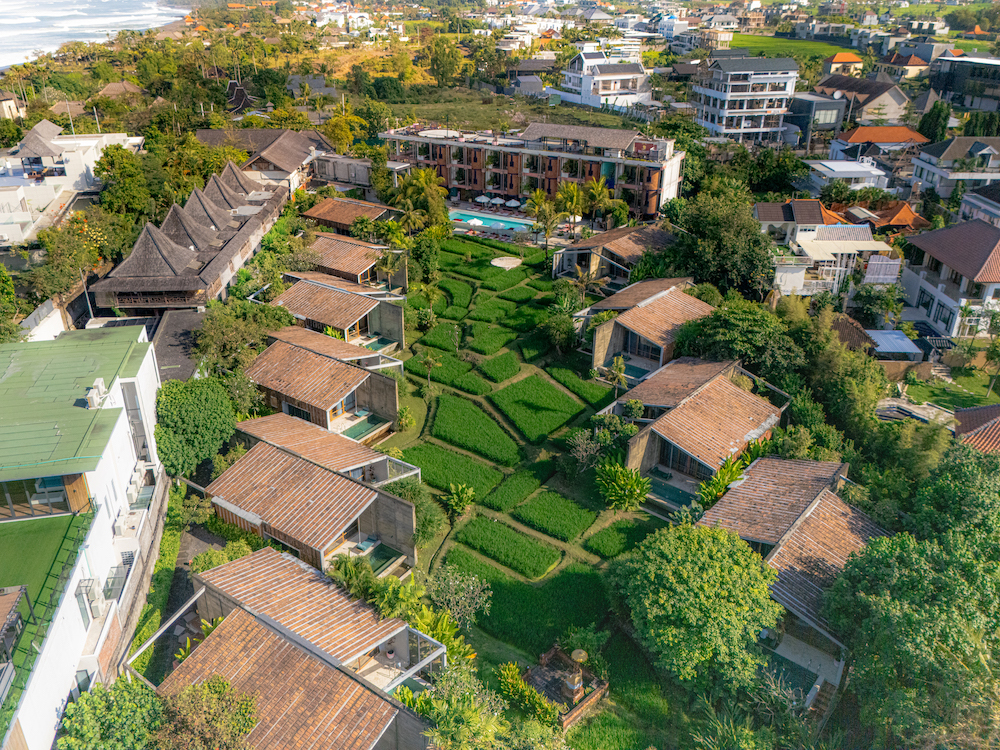
The property was completed in 2019 by Manguning Studio, the Denpasar architectural practice also behind Kintamani’s striking Desa Oculus. The brief they were handed was far from straightforward: to weave postmodern contemporary design into a setting rooted in Balinese architectural tradition. Rather than dissolving that tension into reassuring marketing language, the studio chose to name the challenge openly in its project documentation — an unusually honest position, and one that shaped everything that followed. The resulting vocabulary is unmistakably its own: exposed concrete, terracotta, locally sourced stone, and salvaged timber recovered from concrete scaffolding and reborn as wall cladding. This is brutalism with a conscience and a supply chain; its materials travel short distances and make no attempt to masquerade as anything other than what they are.
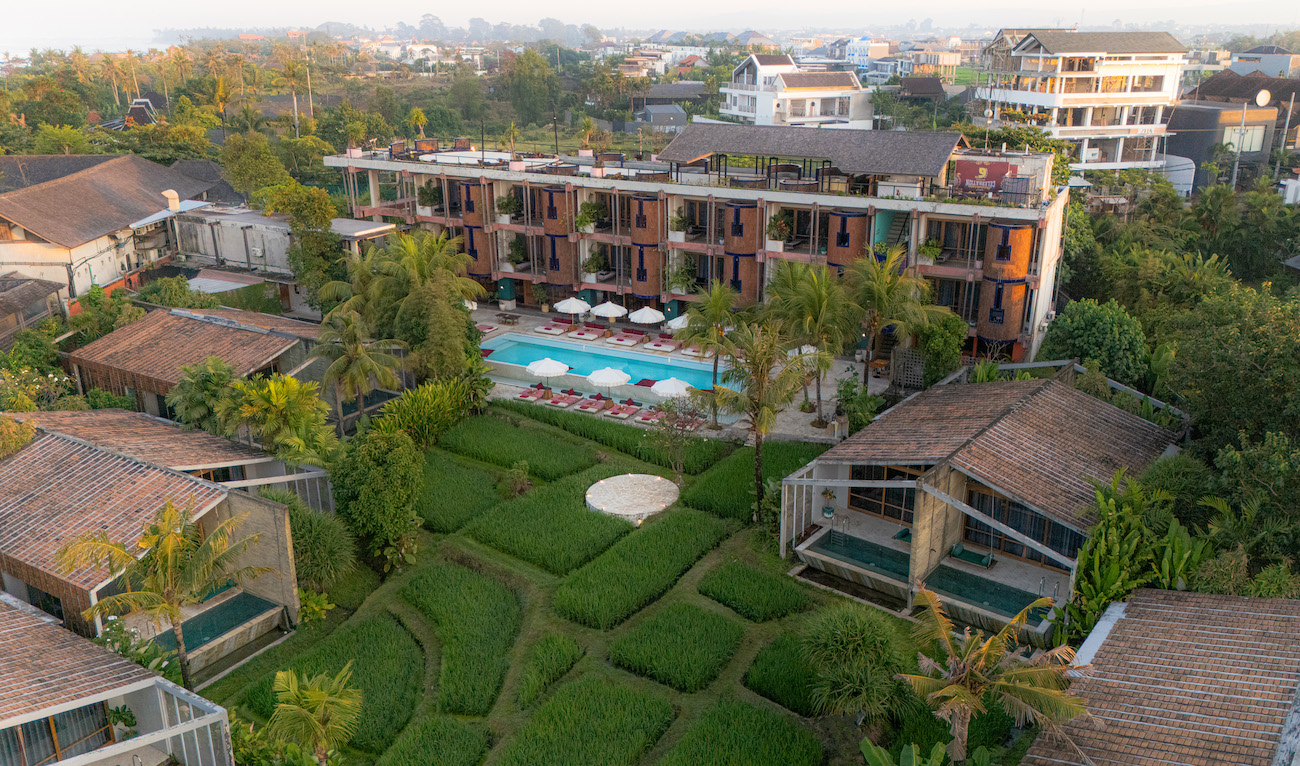
The property’s defining gesture, however, is structural rather than decorative. Both villa wings are positioned at 45-degree angles to the site’s central axis — not as an exercise in aerial spectacle, but so that every single room faces the rice paddy. Concrete walls quietly absorb the sightlines between units, preserving the intimacy of each outlook, while the swimming pool — stretching to nearly half the length of an Olympic pool — follows the same orientation. Toward the field, never the street. Across eight thousand square metres, the entire spatial logic of the resort defers to a working landscape rather than a lobby sequence, and the effect on the atmosphere is profound. The ambition here is quieter than most. It simply asks you to look at something real.
A Living Rice Paddy, and the Farmer Who Tends It
At the heart of the resort lies its most earnest and most persuasive feature. Shore Amora describes itself as the only resort in Canggu with an in-house living rice paddy, and the claim is given substance by the people who maintain it. Local farmers tend the field using traditional methods, and the harvest finds its way back to the hotel kitchen. The farmer at its centre, Pekak Aga, has worked this land since the property opened — a detail, corroborated by the hotel’s own materials, that rings truer than any quantity of “locally inspired” brochure copy.
What makes the paddy remarkable is not simply that it exists, but the role it plays in the resort’s visual and emotional architecture. It does not soften the concrete; it challenges it. The dialogue between working landscape and uncompromising design produces a mood entirely Shore Amora’s own — cultivated rather than staged, specific rather than interchangeable. For travellers weary of tropical-luxe sameness, this single relationship between concrete and paddy is reason enough to book.
The Practical Truths: An Adults-Only Hideaway With Honest Boundaries
Shore Amora is refreshingly unembarrassed about what it is not. It is an adults-only resort; children under twelve are not accommodated. Reception runs through the night, but room service ends at nine in the evening — a cut-off earlier than most design hotels at this level would care to publish. It is a detail that says something sincere about the property’s self-image: this is not a resort that flatters its guests with relentless availability, and there is integrity in that restraint. Travellers who prize uninterrupted seclusion over round-the-clock indulgence will find the arrangement entirely sympathetic to the way they actually want to travel.
Boheme: All-Day Dining That Earns Its Reputation
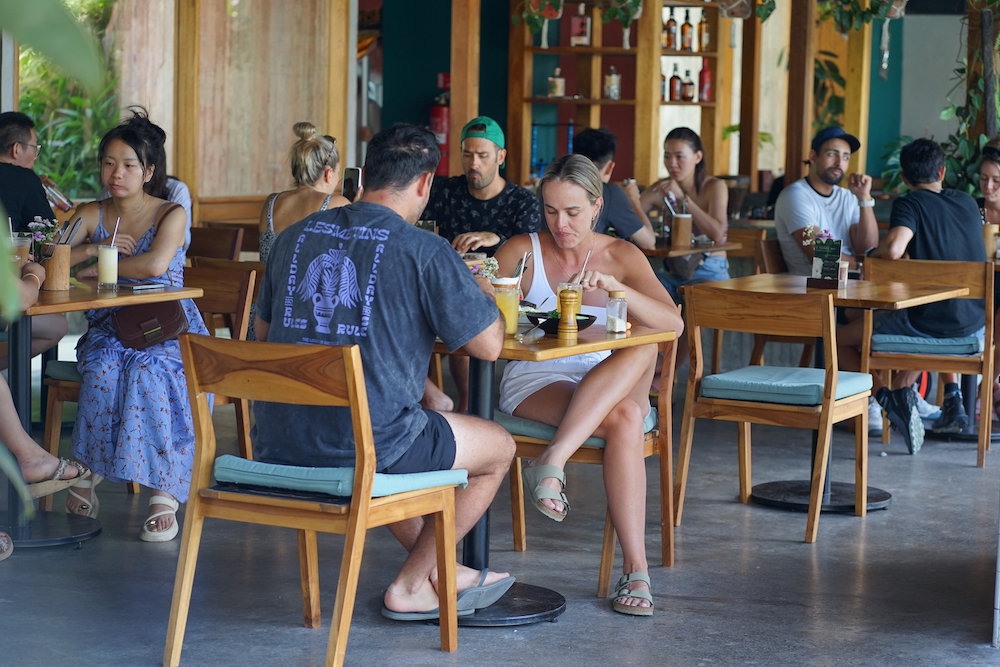
The in-house restaurant, Boheme, trades in the produce-driven, health-conscious Western cooking that Pererenan has come to do better than almost anywhere on the island. Its most persuasive endorsement comes not from critics but from guests themselves — one quote in the hotel’s own journal singles out what it calls the best bread in town, and bread, of all kitchen endeavours, is the thing that cannot be disguised by clever plating. The broader menu moves comfortably between superfood bowls, comforting classics and cocktails composed for the pool-and-field panorama, making it an appealing refuge on evenings when the wider world asks too much. It has not yet become the reservation that replaces Sensorium or The Shady Shack — but as reasons to stay in for the evening go, it is a persuasive one.
Wellness With a Sense of Place: The Jani Spa
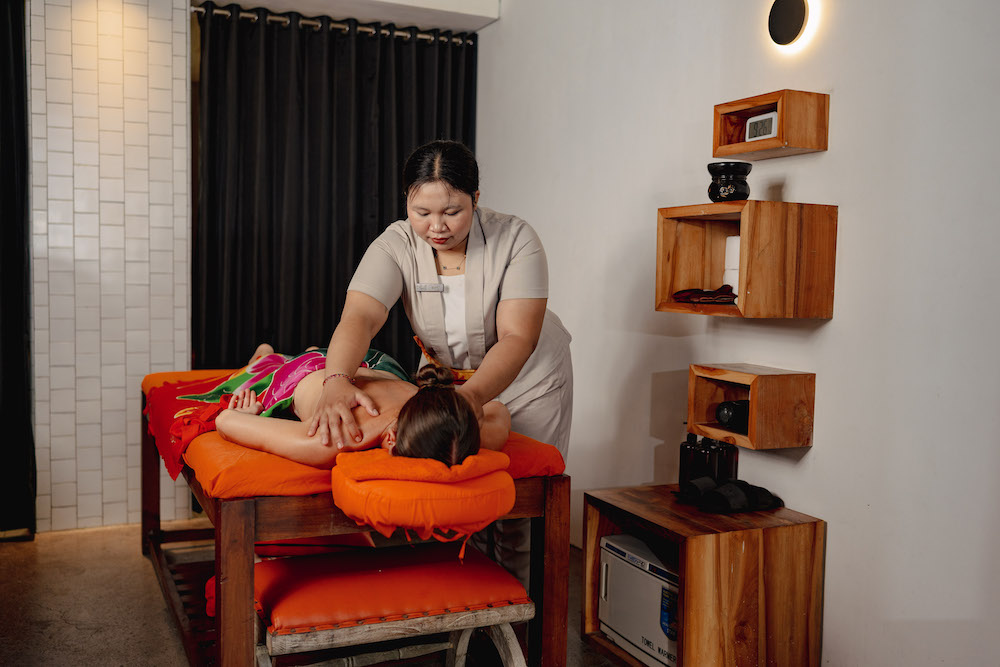
The spa programme is anchored by a treatment of genuine local provenance: the Balinese Boreh Body Polish, a warming ritual traditionally used by rice farmers after long days in the fields. It closes a graceful circle between the paddy at the centre of the resort and the treatment table, and it feels less like thematic marketing than authentic place-making. One small practical note for planners: published spa hours vary across the hotel’s own pages, so it is worth confirming times with reception before booking a treatment.
Designed for the Way We Work Now
For those blending travel with work, The Nomad co-working space substantiates the hotel’s promise more convincingly than most hotel “work amenities” manage. More than twenty seats, hours stretching from 7am to 10pm, fast Wi-Fi attested to by guests in the hotel’s own journal, an ergonomic fit-out and the capacity to host events of up to thirty. Remote workers operating at full professional tilt may still want to verify speeds and enquire about quiet space for calls — the pitch is partly aspirational, though for most it will prove entirely sufficient.
Shore Amora At A Glance
Setting:
Pererenan, one kilometre beyond Canggu’s crowds, on Bali’s southwest coast
Location:
Jl. Pantai Pererenan, a five to seven minute walk from the beach
Completed:
2019
Hotel Concept:
Postmodern contemporary design in dialogue with Balinese architectural tradition — raw concrete, terracotta and reclaimed timber arranged around a living rice paddy
Architect:
Manguning Studio, Denpasar
Accommodation:
Two villa wings angled at 45 degrees so that every room faces the rice paddy
Signature Feature:
An in-house living rice paddy — the only resort in Canggu with one — tended by local farmer Pekak Aga using traditional methods, with the harvest returning to the kitchen
Dining:
Boheme, the all-day restaurant known for its artisan bread, produce-driven dishes and poolside cocktails
Wellness:
Jani Spa, home to the Balinese Boreh Body Polish, a treatment traditionally used by rice farmers
Work & Events:
The Nomad co-working space, open 7am–10pm with more than twenty seats and capacity for events of thirty
Best For:
Adults only — design lovers, creative couples and remote professionals; children under twelve are not accommodated
Know Before You Go:
Room service closes at 9pm; the beach is a short walk away but this is not a beachfront property
Nearest Airport:
Ngurah Rai International Airport (Denpasar)
Website:
shoreamora.com
Editor’s Highlight:
The daily theatre of a working rice paddy, framed from every room, with farmer Pekak Aga still tending the land as he has since the resort first opened
Shore Amora • Pererenan • Canggu • Bali • Indonesia
Pererenan on the Doorstep
Beyond the gate, the neighbourhood rewards exploration. The Pererenan dining circuit is among Bali’s most vital, with Hippie Fish, Blou, Shelter, Sazón and The Shady Shack all within easy reach. The beach itself is a pleasant five to seven minute walk depending on pace and the state of the road. It is worth being precise about what this means: Shore Amora is a walk-to-beach property, not a beachfront one. For guests whose holiday revolves around the ocean, that distinction matters. For those drawn by the architecture, the paddy and the particular rhythm of this village, the trade is a generous one.
The Verdict: A Resort That Knows Exactly What It Is
Shore Amora makes no performance of warmth it does not possess. Its architecture asks something of you before it offers comfort; its boundaries are stated plainly rather than softened. Yet this is precisely its strength. The guest who arrives understanding the proposition — the creative professional on a working sojourn, the couple who have graduated from villa culture and want something that resembles how they actually live — will find the hotel disarmingly accurate to who they are. The guest who booked on the expectation of a conventional Canggu beach holiday will discover something more specific instead. Which of the two it proves to be is, ultimately, the question Shore Amora poses at every checkout — and for a certain kind of traveller, the answer is unequivocally worth the journey.
For more information and bookings visit www.shoreamora.com
Explore the Full Bali Luxury Travel Guide 2026
From the cliffside resorts of Uluwatu and the creative energy of Canggu to the wellness retreats of Ubud and the beach clubs of Seminyak, Bali remains one of the world’s most compelling luxury destinations.
Discover our complete Bali destination guide featuring the island’s finest hotels, restaurants, beach clubs, wellness escapes and travel experiences:
View the Bali Luxury Travel Guide
Luxury Travel Guide Series • Bali Edition